MARCUS
MARCUS, co-first-authored by Mohammad Asadi at Stanford: an agentic multimodal model that reads ECG, echo, and cardiac MRI for cardiac diagnosis.
MARCUS: An Agentic, Multimodal Vision-Language Model for Cardiac Diagnosis and Management
Mohammad Asadi*, Jack W. O’Sullivan*, Lennart Elbe, Akshay Chaudhari, Tahoura Nedaee, Francois Haddad, Michael Salerno, Fei-Fei Li, Ehsan Adeli, Rima Arnaout, Euan A. Ashley · arXiv, 2026
* Co-first authors (equal contribution)
TL;DR
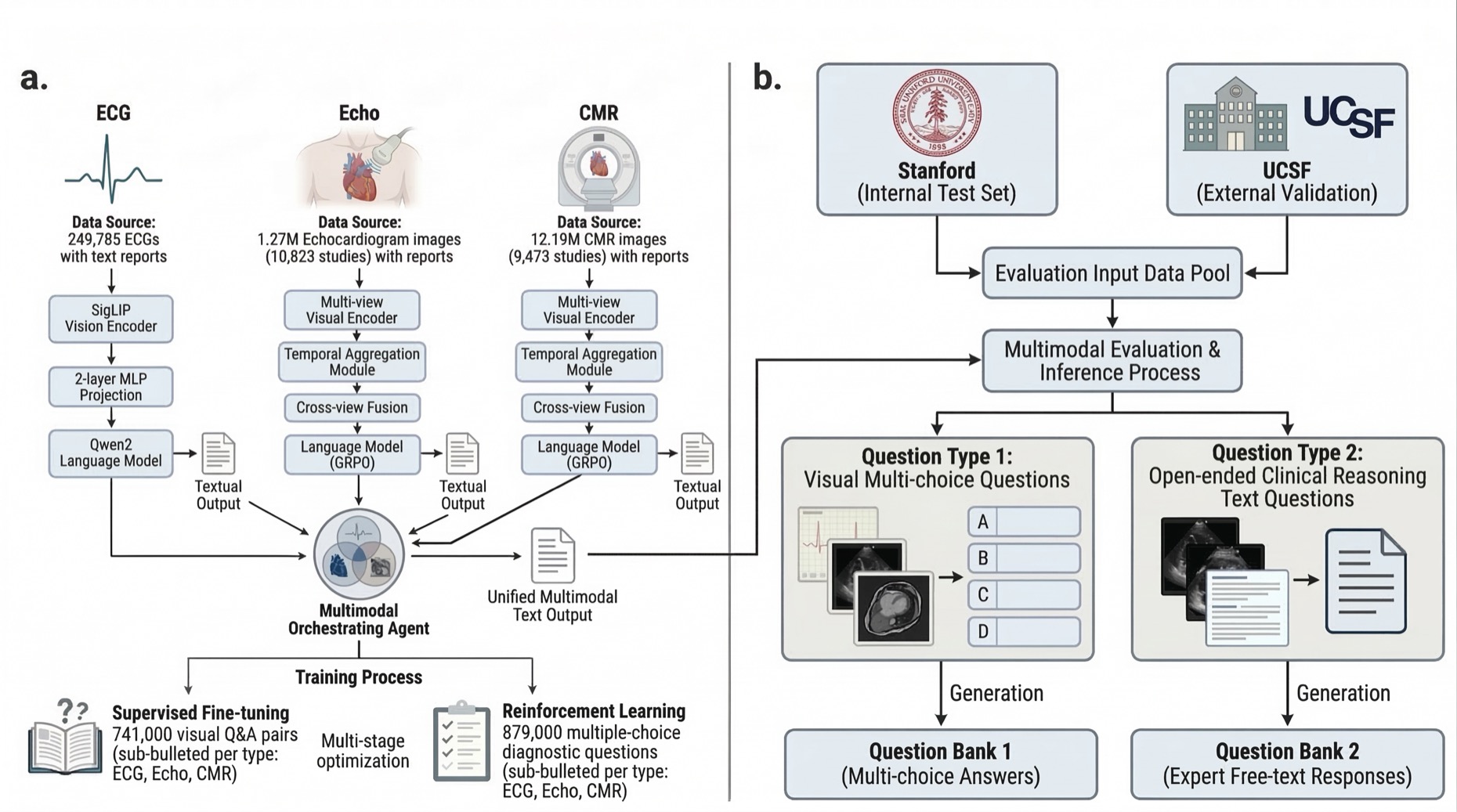
MARCUS (Multimodal Autonomous Reasoning and Chat for Ultrasound and Signals) is a 2026 Stanford system, co-first-authored by Mohammad Asadi, that reads and reasons over ECG, echocardiography, and cardiac MRI (individually or jointly) and can converse about them. Modality-specific expert models are coordinated by a multimodal orchestrator. Key numbers from the paper:
- Trained on 13.5 million images (250K ECGs, 1.3M echo images, 12M cardiac MRI images) plus a 1.6-million-question curated dataset.
- Accuracy of 87 to 91% on ECG, 67 to 86% on echo, and 85 to 88% on cardiac MRI across Stanford and UCSF test cohorts, outperforming frontier models by 34 to 45% (P < 0.001).
- On cases requiring several modalities at once, MARCUS reached 70% where frontier models scored 22 to 28%.
- Individual expert models showed mirage rates of 33 to 38.5%; the full MARCUS system achieved a 0% mirage rate through counterfactual mirage detection in the orchestrator.
What it does
- Reads the three core cardiac tests (ECG · echo · cardiac MRI) and answers questions or writes free-text findings.
- Outperforms frontier models on cardiac tasks by a wide margin.
- By design, resists the “mirage reasoning” failure mode from MIRAGE: it won’t confidently describe what it didn’t actually see.
Why it matters
A trustworthy cardiology assistant has to combine signals and images the way a clinician does, and has to know what it doesn’t know. MARCUS pairs strong multimodal performance with built-in resistance to confident hallucination.